
Put AI to Work on Freight
Turn familiar AI tools into your freight assistant without replacing your team or your systems.
Apply to the Private Pilot
The unseen engine connecting AI to freight.
We built the infrastructure that nobody sees and everybody uses, unlocking connections between freight software, carriers, and AI.
Now your AI can handle the busy work so your team can handle the customers. pull quote info from PDFs, spreadsheets, and emails.
What we're not
- Another TMS
- Just an AI wrapper
- An agent builder
- A replacement for your full tech stack
What we are
- A toolkit that lets your AI work alongside your TMS, not replace it
- Real carrier integrations under the hood that underpin your AI tools
- You bring the agent (Claude, ChatGPT, your framework of choice). We equip it with freight abilities.
- AI functions for your system of record without months of custom development
See it in action
A small sample of what can happen when native AI capabilities meet freight functions.
Out of the box, even capable models can't reach carrier systems. The conversation stops at the answer it can't give.
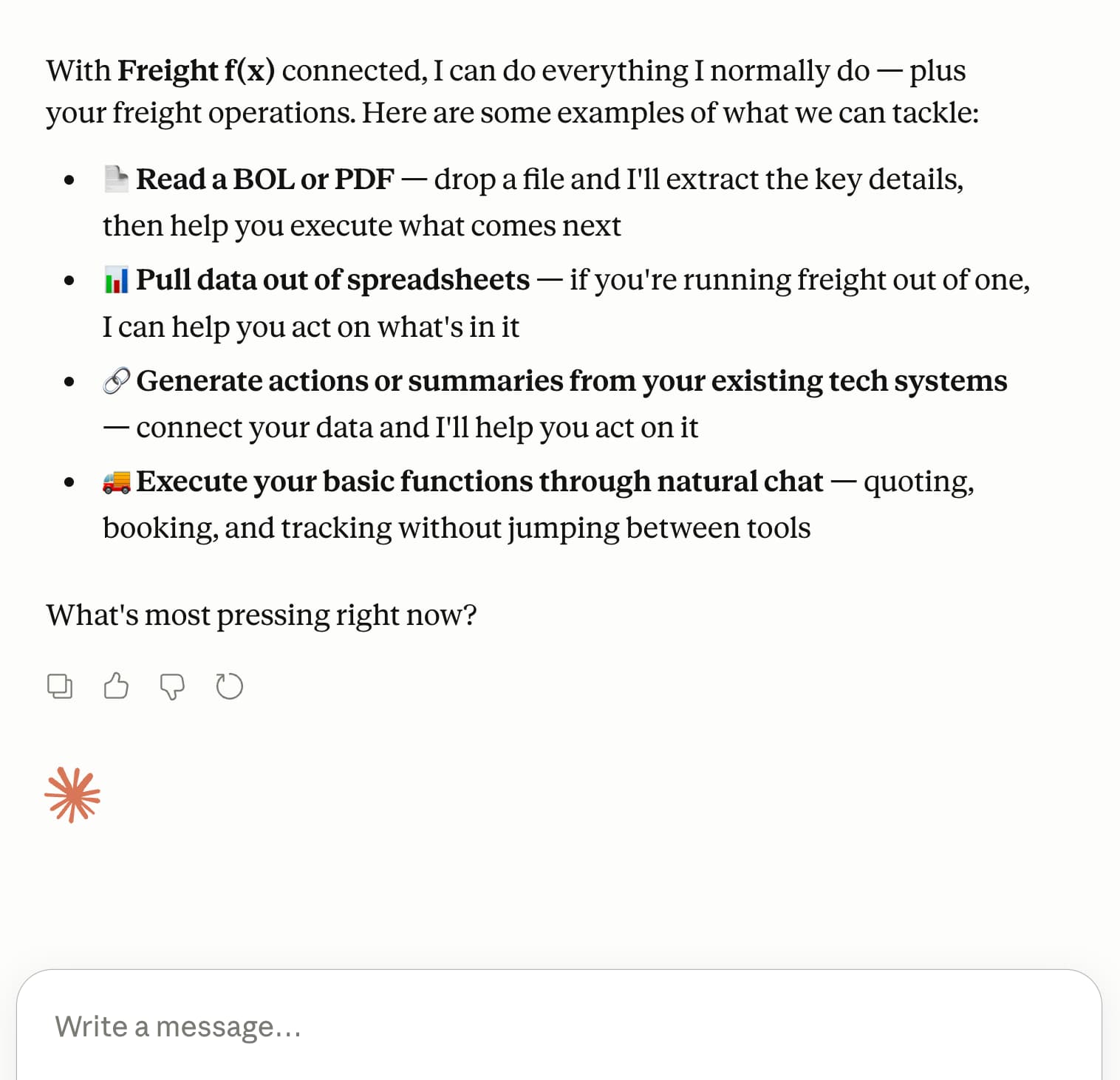
The same AI, now connected to live carrier operations.
Pull a live status and draft the client email in one turn.
Read the quote request, run the numbers, and draft the reply — all in one chat.
What you can expect
- Ship AI-driven freight features without a year-long integration project
- Cleaner, more accurate operations on the work AI takes over
- More loads managed per agent without adding headcount
Apply to the Private Pilot
We're ready to work with a small group of freight operators who want hands-on access, a direct line to the team, and a head start on what AI can do for their operation.
Frequently Asked Questions
What happens once FreightFx is plugged in?
It becomes part of how the work gets done by giving your AI the ability to perform common carrier operations (think quoting, booking, tracking, etc.). Your AI can't do this automatically without FreightFx. It also handles the manual, document-driven work your team handles today: reading BOLs, reconciling invoices, pulling data from emails.
Won't OpenAI or Anthropic just build this themselves?
They technically could, but they've built tools to encourage projects like ours to fill the gaps for specific industry functions that they're not focused on. Their job is making smarter models. Our job is giving those models the ability to help you with freight work.
Isn't this just an AI wrapper?
No. We built the technical layer that does the unglamorous critical work that people can create a wrapper on top of. We handle the complexities of translating between dozens of carrier APIs, normalizing freight-specific data formats, handling the edge cases that break automation. The AI sits on top of that. Without the engineering underneath, the AI has nothing to act on.
I'm already building my own freight software. Where do you fit in?
Underneath. Most teams building freight software end up rebuilding the same carrier integrations from scratch, then maintaining them forever. FreightFx handles that layer so you don't have to. You get carrier connectivity as infrastructure, and your team focuses on what makes your product different. Whether you're a TMS tech team or building something custom, we plug in below your stack.
Do I have to replace my TMS to use FreightFx?
No. We're additive, not a replacement. Your TMS stays where it is, your carrier relationships stay where they are, but your team now gets to do its work with AI. FreightFx sits underneath, connecting your AI to the carriers and systems you already use.
What if my carrier isn't on your list yet?
We can usually add a carrier in days, not months. Our system reads carrier API docs and builds the integration semi-automatically. What used to take engineering teams weeks or quarters now takes us hours of focused work, with a quality-check pass before it goes live.